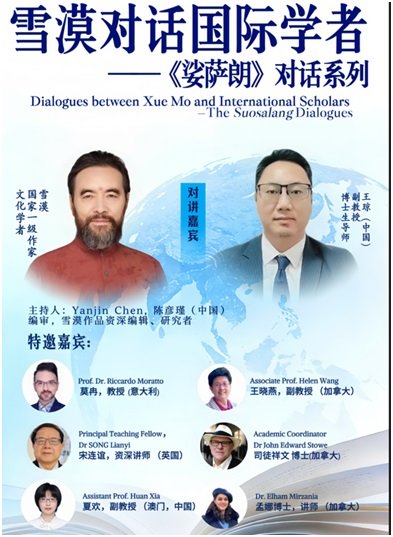
东西方思想的碰撞,探索人类文明新可能
——“《娑萨朗》国际对谈”首次云端对话成功举办
Dialogue
between Xuemo and International Scholars (Session One)
A
Collision of Eastern and Western Thought Exploring New Possibilities for Human
Civilization — The 1st Online International Dialogue on SuosalangSuccessfully
held via zoom
2026年2月8日,一场高规格的国际线上学术会议成功举行。此次“《娑萨朗》国际对谈”由世界文学联合会与雪漠基金会联合主办,吸引了来自中国、意大利、加拿大、英国、伊朗等多国的著名学者、汉学家齐聚云端,围绕中国作家雪漠先生出版的八卷本长篇史诗《娑萨朗》,展开了深度交流与思想激荡。
On
February 8, 2026, a high-level international online academic dialogue was
successfully held. This “International Dialogue on Suosalang” was jointly
organized by the World Literature Union and the Xuemo Foundation, bringing
together renowned scholars and sinologists from China, Italy, Canada, the
United Kingdom, Iran, and other countries for an in-depth exchange of ideas.
Centered
on the eight-volume epic Suosalang by the Chinese writer Xuemo, thisdialogue
featured profound discussions and vibrant intellectual dialogue.
本次会议由人民文学出版社编审、雪漠作品资深编辑陈彦瑾主持。她对与会嘉宾表示热烈欢迎,并指出此次会议旨在通过全球性的跨文化、跨学科对话,深度挖掘《娑萨朗》这部汉语文学史上里程碑式作品的文学价值、文化内涵与国际传播潜力。
The
dialogue was hosted by Chen Yanjin, senior editor at the People's Literature
Publishing House and longtime editor of Xuemo’s works. She warmly welcomed all
participants and noted that the dialogue aimed to explore, through a global
cross-cultural and interdisciplinary exchange, the literary value, cultural
depth, and international dissemination potential of Suosalang, a landmark work
in the history of Chinese literature.
文学与科幻的交汇:从内在探索文明新路径
The
Convergence of Literature and Science Fiction: Exploring New Paths for
Civilization Through Inner Discovery
会议的核心议题之一,是探讨《娑萨朗》与科幻文学的深刻联系。主谈嘉宾、中国著名作家雪漠在介绍其创作初衷时表示,《娑萨朗》并非一个传统的故事性史诗,而是一部“全息的文明”探索之作。他提出,人类在现有文明模式之外,是否可能开启一种新的文明形态?与马斯克从科技角度探索不同,雪漠的探索在于文学与艺术。他认为,《娑萨朗》中描绘的多个“娑萨朗”世界,正象征着人类对新兴文明可能性的探寻。
One
of the central themes of the dialogue was the profound connection between
Suosalang and science fiction literature.The keynote speaker, the renowned
Chinese writer Xuemo, explained that Suosalang is not a traditional narrative
epic, but rather an exploration of a “holographic civilization.” He raised the
question of whether humanity might open up an entirely new form of civilization
beyond existing civilizational models.Unlike Elon Musk, who explores future
possibilities through technology, Xuemo’s exploration is rooted in literature
and art. In his view, the multiple “Suosalang” worlds depicted in the work
symbolize humanity’s search for emerging possibilities of civilization.
与谈嘉宾、广西民族大学王瓊教授从科幻与哲学角度切入,提出了“当世界毁灭,AI是否能创建一个不同的新世界?”以及“这部史诗最核心的文学主题是什么?”等深刻问题。雪漠回应时,超越了对人工智能算法的常规讨论,提出AI可能是一种拥有主体性的“自然智能”或“高维智能”,是人类探索的媒介而非终点。他强调,《娑萨朗》的核心在于“向内寻求”,这与西方文明向外征服的路径截然不同,其目标是探索人类内部世界,从而实现爱与智慧的升华。
Professor
Wang Qiong of Guangxi Minzu University, the key dialogue guest of this session
approached the discussion from the perspectives of science fiction and
philosophy. She raised profound questions such as: “If the world were
destroyed, could AI create a different new world?” and “What is the central
literary theme of this epic?”
In
response, Xuemo moved beyond conventional discussions of artificial
intelligence algorithms and proposed that AI might represent a form of
autonomous “natural intelligence” or “higher-dimensional intelligence” — a
medium for human exploration rather than the final destination itself.
He
emphasized that the core of Suosalang lies in “seeking inward,” a path
fundamentally different from the outward conquest associated with Western
civilization. Its ultimate aim, he explained, is to explore the inner world of
humanity and thereby achieve the elevation of love and wisdom.
王瓊教授进一步阐释,这与后现代哲学中的“内在性”思想相呼应,并指出《娑萨朗》贯穿了人类对“永恒之光”的追求,而“光”正是跨越各大文明的共通精神符号。雪漠在回应“最喜欢的人物”时,选择了“胜乐郎”,认为这个角色代表了对欲望的正面超越,是每个人在红尘中历练、最终实现精神升华的标本。他总结道,《娑萨朗》的价值在于告诉世界:每个人都可以用自己内在的爱与智慧,创造出属于自己的理想世界“娑萨朗”。
Professor
Wang Qiong further explained that this vision resonates with the postmodern
philosophical concept of “immanence.” She noted that Suosalang is permeated by
humanity’s pursuit of the “eternal light,” and that “light” itself serves as a
shared spiritual symbol across major civilizations.
When
asked which character he favored most, Xuemo chose “Shenglelang,” explaining
that the character represents a positive transcendence of desire. In his view,
Shenglelang embodies the journey every individual undergoes in the secular
world — through trials, self-cultivation, and ultimately spiritual elevation.
Xuemo
concluded that the value of Suosalang lies in its message to the world: that
every person can create his or her own ideal “Suosalang” through the love and
wisdom within.
国际学者多维对话:聚焦“向内求索”的普世价值
A
Multidimensional Dialogue Among International Scholars: Focusing on the
Universal Value of “Seeking Within”
在随后的国际学者对话环节,来自不同文化背景的学者们就《娑萨朗》的精神内核及其对当代世界的启示进行了精彩提问。
During
the subsequent dialogue session among international scholars, participants from
diverse cultural backgrounds raised thought-provoking questions about the
spiritual core of Suosalang and its implications for the contemporary world.
•意大利汉学家莫冉教授结合西方史诗传统提问:在科技消解意义的今天,《娑萨朗》中哪一种“向内求索”的价值最能触动习惯“向外征服”的西方读者?雪漠指出,当外部世界的探索愈发接近“世界是心灵感知的呈现”这一真相时,回归内心、构建以爱与智慧为根基的内在文明,才是人类避免被资本与欲望裹挟、实现和平共处的唯一救赎。
•Riccardo
Moratto, a sinologist from Italy, drew upon the Western epic tradition in his
question: in an age when technology increasingly dissolves meaning, which
aspect of the “inward quest” in Suosalang is most likely to resonate with
Western readers accustomed to “outward conquest”?
In
response, Xuemo observed that as humanity’s exploration of the external world
comes ever closer to realizing that “the world is a manifestation perceived by
the mind,” the only true path to redemption lies in returning inward and
building an inner civilization grounded in love and wisdom. Only in this way,
he argued, can humanity avoid being consumed by capital and desire and
ultimately achieve peaceful coexistence.
•加拿大学者吴小燕教授从自身城市生活背景出发,询问对大城市读者的阅读建议。雪漠以“杯子”为喻,指出阅读《娑萨朗》这类描绘西部自然与质朴生活的作品,能“撑大”被现代都市固化了的生存与精神世界,让人在更广阔的参照系中重新审视焦虑与得失,获得内心的宁静。
•Xiaoyan
Wu, a scholar from Canada, drew upon her own experience of urban life to ask
what kind of reading guidanceSuosalangmight offer to readers living in large
cities.
Using
the metaphor of a “cup,” Xuemo explained that reading works such asSuosalang,
which portray the natural landscapes and unadorned way of life of western
China, can “expand the cup” of one’s existence and spiritual world — realms
that modern urban life often narrows and solidifies. Through a broader frame of
reference, readers may come to reassess anxiety, gain and loss, and ultimately
attain inner peace.
•英国教师宋联谊博士就雪漠常提及的“心中有一盏灯”这一意象追问其具体内涵。雪漠明确赋予了这盏“灯”以评判标准:它必须能为人带来“爱、智慧、健康、快乐”,缺一不可。他强调,并非所有引领个人的“灯”都有益于人类,能给世界带来灾难的“灯”是罪恶的,应予警惕。
Song
Lianyi, a teacher from the United Kingdom, further inquired about the meaning
of the image that Xuemo often invokes — “a lamp within the heart.”
Xuemo
gave this “lamp” a clear standard of judgment: it must bring people love,
wisdom, health, and happiness — none of these qualities can be absent. He
emphasized that not every “lamp” guiding an individual is beneficial to
humanity. A “lamp” capable of bringing disaster to the world is an evil one and
should be approached with vigilance.
•伊朗籍学者孟娜博士则从波斯苏菲文学传统中“痛苦具有精神转化力量”的观点出发,探讨《娑萨朗》中的痛苦书写。雪漠认为,在生命的宏大“剧情”中,苦难是最精彩的篇章之一,是命运馈赠的礼物,如何面对并超越它,取决于个人的选择。
Dr.
Elham Mirzania, an Iranian scholar, approached the discussion from the
perspective of the Persian Sufi literary tradition, which views suffering as a
force capable of spiritual transformation, and explored the portrayal of
suffering in Suosalang.
Xuemo
responded that within the grand “drama” of life, suffering is one of its most
compelling chapters — a gift bestowed by fate. How one confronts and transcends
suffering, he explained, ultimately depends upon individual choice.
此外,来自伦敦大学亚非学院的宋联谊博士、澳门科技大学的夏欢博士、多伦多都会大学的司徒祥文博士与孟娜博士也分别就信念的本质、精神力量的提升、创作心境以及文明的延续等议题与雪漠进行了深入交流。雪漠在回应中进一步阐述了通过“道、德、法、术、势”五维构建个体生命力量的实践路径。
In
addition, Song Lianyi from the SOAS University of London, Xia Huan from the
Macau University of Science and Technology, Dr. John Edward Stowe, from Toronto
Metropolitan University, and Elham Mirzania also engaged in in-depth
discussions with Xuemo on topics including the nature of belief, the
cultivation of spiritual strength, the inner state of literary creation, and
the continuity of civilization.
In
his responses, Xuemo further elaborated on a practical path for building
individual spiritual strength through the five dimensions of “Dao, Virtue,
Method, Technique, and Momentum” (“Dao, De, Fa, Shu, and Shi”).
一场超越文学的心灵对话
A
Spiritual Dialogue Beyond Literature
本次“《娑萨朗》国际对谈”不仅是一场高水平的学术研讨,更是一次真诚的心灵交流。学者们的提问跨越地域与文化,雪漠的回应则深邃而充满智慧,直指人类共同面临的生存与精神困境。会议最终在云端合影中落下帷幕,为后续系列国际对话奠定了坚实基础,也标志着中国当代文学创作正在以更自信、更富哲思的姿态,参与到全球关于人类未来文明图景的深刻对话之中。
The
International Dialogue on Suosalang was not only a high-level academic
discussion, but also a sincere exchange of minds and spirits. The scholars’
questions transcended geographical and cultural boundaries, while Xuemo’s
responses were profound and insightful, directly addressing the shared
existential and spiritual challenges facing humanity.
The
meeting concluded with a group screenshot taken in the cloud, laying a solid
foundation for a future series of international dialogues. It also marked a
moment in which contemporary Chinese literature is increasingly participating,
with greater confidence and philosophical depth, in global discussions about
the future vision of human civilization.






 xuemo.cn/3g

 雪漠推荐
雪漠推荐
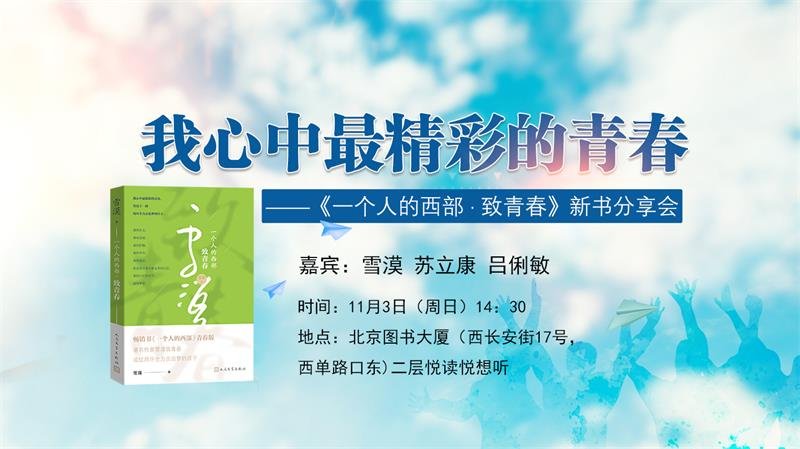 我心中最精彩的青春——《一个人的西部·致